• Collaborative Practice in a Virtual World

    A reflective essay and portfolio into my experience of collaborative musical practice and management during the COVID-19 pandemic. 

    I recently submitted the following to my university, as an assignment about Collaborative practice. It was original supposed to be about performing in community choirs, and interacting as an online representative. COVID-19 pandemic, required me to drastically change perspectives and scope. I got some awesome feedback and got to experience a lot. Enjoy the read through of my journey through the Virtual Arts.

    The original intention of this portfolio was to engage in a community choir in through rehearsal and performance opportunities. I am also responsible for the management of social media of the Brisbane Chorale, including content creation, implementation and engagement.

    On the 30th of January 2020, the World Health Organisation declared ‘COVID-19’ as a “Public Health Emergency of International Concern” (WHO, 2020). This announcement resulted in the shutdown of the Performing Arts around the world and social distancing regulations implemented throughout Australia (Wikipedia. 2020). This limited the opportunity to conduct the original intent of a reflective collaboration in a community group.

    After some reflection about completing the requirements of my course, I have shifted the focus of the collaborative reflection of the utilisation and implementation of digital technologies to achieve a collaborative performance and maintain the viability of physical collaborations for future events. Activities I have collaborated on include the management of social media during the pandemic crises for the Brisbane Chorale, as well as hosting and participating in Virtual Choirs in an open public (international) forum and within the closed forum of the University of Southern Queensland.

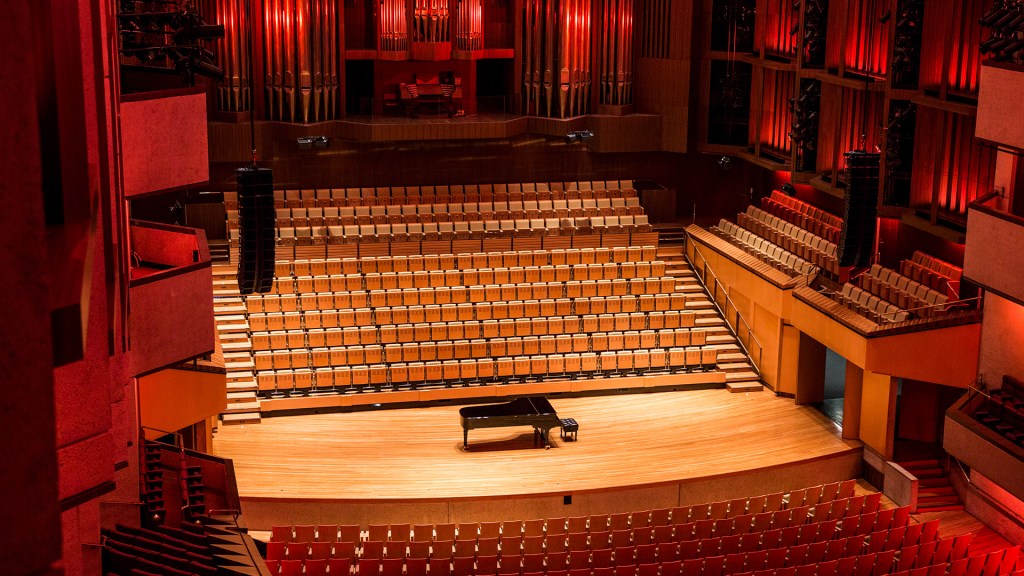
    When the 2020 Season is Shut Down
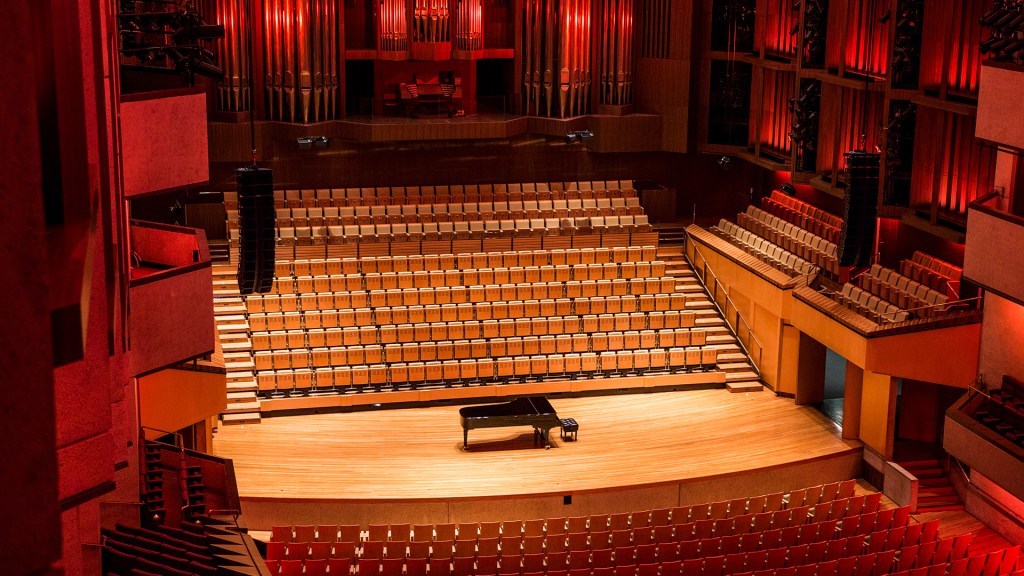
    Empty halls due to COVID-19 pandemic.

    Regulations imposed on the Performing Arts sector was mainly in relation to the social isolation of public gatherings and non-essential movement of people. As such, many workers and organisations are now currently struggling to adapt and utilise technology to keep the industry alive, let alone financially viable for workers and performers.

    In context to the situation in which Brisbane Chorale found itself, this was the cancellation of events immediately after regulations were enforced. Cancellations were made by not only by the Brisbane Chorale, but associated organisations such as the Queensland Symphony Orchestra; and venues such as the Queensland Performing Arts Centre (QPAC) in Brisbane. Evidence of some of these cancellation notifications were sent to members through social media and webmail.

    In my role as Social Media Manager of the Brisbane Chorale, I needed to maintain the social media platforms of Facebook, Instagram and Twitter. I worked in collaboration with the Website Manager, the Marketing and PR Committee and the Executive Committee.

    My role includes content creation, posting images and text online; and the promotion of future events and the organisation (as a recruitment drive) through creation and construction of audio only and audio-visual material.

    The new issues of collaboration… how do we continue?

    Isolation, physical distancing regulations and event cancellations eventually caused bands, choirs and other performing bodies to shut down. Brisbane Chorale was no exception, with the final rehearsal being held on the 11th of March 2020. At the time of writing this reflection, it has not yet been determined when Brisbane Chorale will resume rehearsals.

    Gerald Klickstein states in his book The Musicians Way, “embracing career difficulties as a performer involves several steps that can aid in building one’s career rather than destroying it”. I believe that the following can apply to a group context;

    1. Draft a career plan
    2. Educate yourself
    3. Network
    4. Fill many niches
    5. Polish your image

    (2009. Chapter 14, Section 4. “Embracing Career Challenges”)

    The closures have forced people to seek alternative means of communication and being involved in music and ’embrace the challenge’ that is quickly becoming the new normal. Using resources from the Chorus Connection Blog (2020), the Brisbane Chorale Executive and Marketing Committees were able to come up with a plan and implement online activities to engage both members and audiences.

    Brisbane Chorale Executive and Marketing Committees decided that given there are no longer performances likely to happen in the near future, that this would be a good time to enter a period of “Regroup, Refocus, Rethink…”, allowing for the reassessment and adjustment of policies and mechanisms of the Brisbane Chorale in relation to member and audience engagement, recruitment and general housekeeping of the organisation. 

    In collaboration, we (including myself) engaged and implemented the following activities;

    • Zoom Meetings – utilised mainly for discussion of issues and ideas between members of respective committees.
    • Email– Weekly Newsletter informs members and stakeholders of current situation with rehearsals, events and additional activities that other organisations are undertaking during the period of closure. Although Brisbane Chorale utilises this medium as a formal communication conduit, members have often asked for email addresses to particular members (given with express permission of all parties) for informal communication. 
    • Social Media – It was important to the Brisbane Chorale Executive Committee that the work that I had already done in building an online audience and an online presence of Brisbane Chorale. As such, it became my role to create relevant content that kept audiences informed of events and news pertaining to the Brisbane Chorale and the Performing Arts in industry in Queensland and Australia.
    Psalm 23 Promo Video for public notice.
    • Audio-Visual Content– As I am able to use both audio (Logic Pro X) and video (Final Cut Pro) editing software, it became my role to create audio-visual content for social media platforms and website. There was a process of collaboration where I sought feedback from both committees in producing and publishing the final version that currently appears on social media and the website, through email and Zoom meetings.
    • YouTube Content– A request was made by members, through social media and email, to have a video from the Chorus Master / Conductor Emily Cox AM., about exercise that they could do during the shutdown period. Emily was able to post such a video limited to members.
    • Marketing Plan– The Brisbane Chorale had no previous market schedule or plan when it came to promoting events, recruitment, or general promotion of the organisation. In the rare instance of having no performance to prepare, the committee seized the opportunity to develop a plan to be utilised for the future. This included the role of Social Media, Website and YouTube play in aiding the survival of Brisbane Chorale, as a non-profit community organisation.
    • Social Activities– I have observed that some choirs have held a ‘Wine & Whine’ Social Event through Zoom (2020) for members to make contact with each other and reconnect. Activities could include ‘Watch Parties’, when people link into a single platform at the same time to view material and comment in live time.
    • Virtual Choirs / Band– It was encouraged that members join in virtual projects online, whether that be a choir, band, all utilise an app, like Smule (2020). I found and posted opportunities for activities onto the Facebook Members Page (private setting for current members of the Brisbane Chorale), for members to view and access, if they choose. 

    Keeping Connected through Music

    After discussions, the committee decided to hold a ‘Watch Party’ of “The Brahms German Requiem” (Norwegian Soloists’ Choir. 2020) on YouTube using the website ‘Watch2Gether’ (2020). In preparation for this event, I was required to find a streaming platform that would allow all persons to get involved with the even, not just those linked to social media.

    The event was held on the 29th of April 2020, with attendance of up to forty-five viewers.

    After the event, there was a brief discussion with the  Chorale conductor and president of the executive committee. It was determined that the following issues would need to be addressed before another event can be arranged.

    • A more secure platform is needed. Throughout the session, I had frequent ‘strangers’ come into the viewing room, which I monitored and ‘threw out’.
    • Participants need an easier method of identifying themselves when presented in the forum, whether be the general chat and overall presence in the viewing area.
    • Video needed to be controlled by only one person. Frequently members wanted to rewind or fast-forward the recording. Unfortunately, when this happened, this affected the viewing of the other participants. The proverbial “remote control” situation, need to be addressed.

    Positives included;

    • Positive feedback from participants and membership of the Brisbane Chorale, wanting another similar event held in the near future.
    • The engagement included roughly forty-five members viewing the video at a single time and comment on content.

    Keeping the feedback and issue in mind, the marketing and executive committee decided to do another ‘Watch Party’, using another platform. During a meeting, it was determined that Facebook (2020) would be a more secure platform to allow members to view a video and be identifiable when they made comments in the chat area.

    As this platform (in the context of using it for Watch Parties) is unknown either myself or any member of Brisbane Chorale, it is hard to gauge whether this endeavour will solve the fore-mentioned issues. 

    A second event was held on the 20th of May, viewing Haydn’s “Nelson Mass” (1798) on Facebook (2020), using the watch party facility incorporated into the platform.

    Invites were limited to only the members of the Brisbane Chorale who are also members of the ‘Brisbane Chorale Members’ private group on Facebook.

    After the event, there was another debrief session with the conductor and the president of the Brisbane Chorale.

    • The platform was definitely more stable during playback, with control only being an option for the host (AKA myself). It was also more secure for group privacy and comment.
    • Engagement was not as high as the last watch party (twenty-seven at the most). This was due to many people being unavailable, as well as being limited to those members who have a Facebook account are members of the ‘Brisbane Chorale Members’ group page.
    • The session was viewable for a week after the event on the members page, so those who missed the event could watch after the fact, or for those to re-watch and add additional comment.

    Engagement seems to be the key aspect as far as getting enough traffic through an online event to make it socially viable and relevant to the Brisbane Chorale. The difficulty is in finding a platform that is suitable to most members, as not all members can be catered for unless items and opportunities are posted and hosted on more than one platform. 

    Security and privacy issues then play a part in making sure that what is said and done in the group, stays within that group or at least released with group or organisational consent.

    Brisbane Chorale have decided to schedule more Watch Party’s in the future showcasing various choral pieces. It was concluded that having a means to connect with each other is important in maintaining the future integrity of the choir and prepare for the time when rehearsals and performances can resume.

    Undertaking the journey…

    Feedback from the members during the ‘Watch Party’ also included requests for more social gatherings for member to access. Early in the preparing this portfolio, I decided to undertake  a process of investigation, experimentation and reflection upon the concept of virtual choirs and bands, with possible opportunities to collaborate with multiple audiences. This would address the criteria of critical reflection in a collaborative setting. 

    As such, I researched how to put together a virtual choir in the chance that I would be able to lead a project. I also searched for opportunities to participate in virtual choirs in other organisations, platforms and forums. For myself, the search was to provide an outlet musically, as well as maintain my choral skill set as a singer.

    At the conclusion of this portfolio, I had come upon or created the following opportunities;

    1. Open Forum (Public) Collaboration (See Public Collaborations using Apps)1
    2. Open Forum (Limited Access) Virtual Choir (See Eric Whitacre’s Virtual Choir 6)2
    3. Closed Forum (Limited Access) Virtual Choir / Band (See USQ Virtual Choir / Band)3
    4. Closed Forum (Private) Virtual Choir (See Brisbane Chorale Virtual Choir)4
    1. Denotes that invitations are open to the general public, or that there is no restriction as far as access is concerned within the platform in which the collaboration has been posted.
    2. Denotes the invitation is limited to members who subscribe or have access to associated platforms. In this case this is through direct email or social media platforms. Contributions are otherwise open to the participants that contribute.
    3. Denotes limited accessibility within a certain community or group online. In this case to the USQ Creative Arts students.
    4. Denotes limited accessibility to within a group. Inclusive to only members. No general contribution from outside the group is accepted. 

    What is a Virtual Choir?

    A Virtual Choir is a choir that is composed by members who are isolated from each other. Virtual choirs are often national or global affairs. 

    Eric Whitacre, pioneer in the concept of virtual choirs, defines a virtual choir as:

    “…creating a user-generated choir that brings together singers from around the world and their love of music in a new way through the use of technology. Singers record and upload their videos from locations all over the world. Each one of the videos is then synchronised and combined into one single performance to create the Virtual Choir.”

    (Whitacre, Eric. 2020)

    Another brief definition is also given in Karen Savage’s book, Economies of Collaboration in Performance (2018);

    “The idea of a virtual choir is one in which contributors film their own solo rendition of a piece of music on their webcams. The files are then brought together and screened simultaneously so that an audience sees and hears an entire collective singing…collaborations and communities can be formed by people across time and space, and bouncing between the resources of both the technological sphere and the natural world.” 

    (2018. p.469 & 687)

    In early 2018, I had the opportunity of joining Eric Whitacre’s Virtual Choir 5 project “Deep Field: Earth Choir”. The piece was original  commissioned as an orchestral suite by the National Aeronautics and Space Administration (NASA) in celebration of the 30th Anniversary of the Hubble Space Telescope being in service.

    Deep Field: Earth Choir (Virtual Choir 5)

    Eric Whitacre publicly engaged singers from around the world to contribute a video towards the fifth virtual choir (hence called Eric Whitacre’s Virtual Choir 5). Over 8000 participants engaged in the project from 120 countries, culminating in the video which was broadcasted throughout social media, YouTube and the Discovery Channel. It was also screened at eh celebrations at the Kennedy Space Centre, United States.

    My headshot appears on the ‘Deep Field’ Website

    Since its publication in late 2018, I have seen many virtual choirs appear on social media and YouTube. Since the closure of performance groups and venues, virtual bands and choirs have started to appear on multiple platforms. Some of which have been included in video references below.

    During the process of participating in Virtual Choir 5, I was asked to participate in a study about the physical and emotional health of singers. The focus of the study is a comparison between virtual choirs and physical choirs. The final study was published in on the 10th April 2019, in the Frontiers in Psychology journal and website (Fancourt, D., & Steptoe, A. “Present in Body or Just in Mind: Differences in Social Presence and Emotion Regulation in Live vs. Virtual Singing Experiences”).

    Video References

    • “Run For Your Lives” (Virtual Beatles): (Jun626. 2009, September 13).
    • “Here Comes the Sun” (Camden Voices): YouTube (2020, April 10).
    • “Close To You” (Couch Choir / Pub Choir): YouTube (2020, March 22).

    Public Collaborations using Apps

    Role: Host, Participant

    Background

    I am very familiar with open forum collaboration apps such as Smule (2020). The app allows for a free or subscribed access to backing tracks, recording either audio or video. Smule also allows for solos, duets or group collaborations. After recording is complete, the app allows for the collaborations to be posted on Social Media, YouTube, and the Smule online platform (which allows for playback only). All platforms mentioned have the capacity for feedback, in comments, messages, forums or chat.

    Process:

    I wanted to select songs that would be familiar to small groups of people. I chose the following;

    • “Skye Boat Song” (2014) – I chose this piece because it is a relatively well known traditional folk piece. It also has a new popularity being the theme song for the Outlander television series
    • “I Am Australian” (1987) – Given the environment of isolation, I wanted to perform a piece that was relevant to Australian society. I also knew that I would be narrowing my audience and potential collaborators. 

    I recorded each piece on video using my iPhone and headset (microphone and headphones) and uploaded to the Smule platform as a group collaboration for others to participate. After 14 days the collaboration closed (as by conditions set by Smule). The resulting videos are made available to all participants for posting to social media, etc.

    Reflection

    Some of the positives outcomes of collaborating in an open forum is that for the most part, people who participate in these group collaborations, want to be a part of the collaboration. Smule gives the option for users to opt in audio only, which is great to increase potential participation of those who do not want to appear in video. The Smule platform allows for users to participate in a safe environment, with a reporting mechanism in place should inappropriate videos, behaviour or comments are made.

    Negatives implications include the quality of the performance. The ability to mix sound only occurs after recording your own contribution, with no opportunity to do a final mix at the end. 

    The quality of performance is also dependent upon the quality participants who join, this can be a mix of semi-professionals through to those who love to sing as a hobby, as such continuity in performance is often very rough. The concept of Smule is to provide connection to strangers who love to sing, not to record professional clips, so it is justifiable that there are some limitations by having an open forum.

    In the past, I have had some feedback from users, saying that they don’t feel adequate to sing with me, due to my skill already established from previous years of practice and performances. Engagement is limited to those that have the confidence to join in the collaboration.

    I try to reply and thank those who participate in my collaborations and encourage them to continue singing in the app and in their own communities.

    References to Media

    • “Skye Boat Song”: (Smule, 2020) Record in April 2020. Collab was posted on the Smule Sing! forums as an open invitation for subscribers and users to participate.
    • “I Am Australia”: (Smule, 2020) Record in April 2020. Collab was posted on the Smule Sing! forums as an open invitation for subscribers and users to participate.

    Eric Whitacre’s Virtual Choir 6

    Role: Participant 

    Background

    On the 3rd of May 2020, Eric Whitacre launched ‘Virtual Choir 6’, in response to the isolation felt across the performing arts around the world. Prior to the launch, members of previous virtual choirs were contacted and alerted to the launch. The new piece is called “Sing Gently” (Whitacre, Eric. 2020).

    After registering online for the project, I was granted access to resources to prepare, practise and record my contribution to the virtual choir. Resources included sheet music of ‘Sing Gently’ from the “Virtual Choir 6” Website (2020).

    Links to Eric Whitacre’s YouTube page (2020) also provided videos of the overall piece with all parts demonstrated by soloists, separate part recordings (Soprano, Alto, Tenor and Bass), and introduction and overview by the conductor himself.

    On the ‘Join The Choir’ webpage of the Virtual Choir website (2020), there are step-by-step instructions on how to record, and upload contributions. The website also states who will be involved in the project as support for putting the final project together in audio and video.

    Process

    After downloading and viewing the sheet music and YouTube videos, I recorded myself singing only the soprano part, to ascertain where I was as far as quality of my voice. Even though this piece is a contemporary piece, the style is that of a polyphonic1 frottola2 or early madrigal. (Burkholder, et al. 2014 ). As is characteristic of this form of music3; filled with long sustained notes, and flowing movement throughout phrasing, I need to control breathing when rehearsing this piece. 

    Initially, I found my voice struggling to maintain tonality required, with some sliding pitches. After further warm-up and exercises, I was able to sustain notes better, however I will need to all a longer vocal warm up performing this piece.

    During isolation projects, I have found it helpful to reach out and connect with other people involved in the project. Eric Whitacre created a Facebook and Twitter page to do just that. As such, I have been able to introduce myself to others around the world.

    Since directives by Eric Whitacre and producers stated that I needed a plain background and wearing a block colour; I constructed a background out of a door, lamp, ceiling fan and a bedsheet. I also set up my own microphone and headphones (like a recording studio setup), through my laptop. I used Photo Booth (2018) app, which comes standard on an Apple operating system. 

    Contribution to Virtual Choir 6: “Sing Gently”

    After my contribution to the Virtual Choir and submitted it through the relevant link. I received a certificate and a posting on the website of my headshot on the Virtual Choir 6 Website (2020).

    Reflection

    Reflecting upon my own performance, I have always found it strange to hear myself, without any accompaniment. I need to be more confident that I am in the position to perform on my own (literally), and be sure of pitch, rhythm. Being more self-reliant, rather than relying on another instrument to assist.

    My headshot on “Sing Gently” Virtual Choir 6 website.

    Experiences from the overall project included connecting to people of like mind and interests through social media. Facebook provided a link to people who had questions or advice requests, and we were able to collaborate in providing that advice, and assistance. This helped to foster a sense of community among strangers.

    Some negatives that came from this project personally was finding the time to actually record in an environment that would be appropriate. Though I do not live in a busy neighbourhood, my home is not soundproof, so you can hear cars and noise outside, as well as a few indoor noise from other members of my family, despite me telling them that I was recording.

    Time was an issue, because of work and life commitments. Being one of the few occupations that wasn’t stood down during the pandemic lockdown, I often came home exhausted and not able to produce a sound appropriate for recording. I was able to allocate myself time on the weekend to complete the project, so I need to be able to make that time to contribute to collaborations.

    There is a sense of disconnectedness after submitting your contribution to a Virtual Choir, like the post-show depression one feels. I have found myself scouring the social media, to see where everyone else is up to and providing advice and comments to posts. I have often questioned myself whether this practice is actually productive to the process of collaboration, when my contribution is already completed. I further question myself as to how I am justifiably qualified to help others in their recordings, being very much aware of ego and feelings, in s supposedly senseless and theoretically emotionless platform. 

    Outcome

    At the time of completion of this portfolio, a release date for the completed virtual choir had not been announced. It is estimated that release would be in late July 2020.
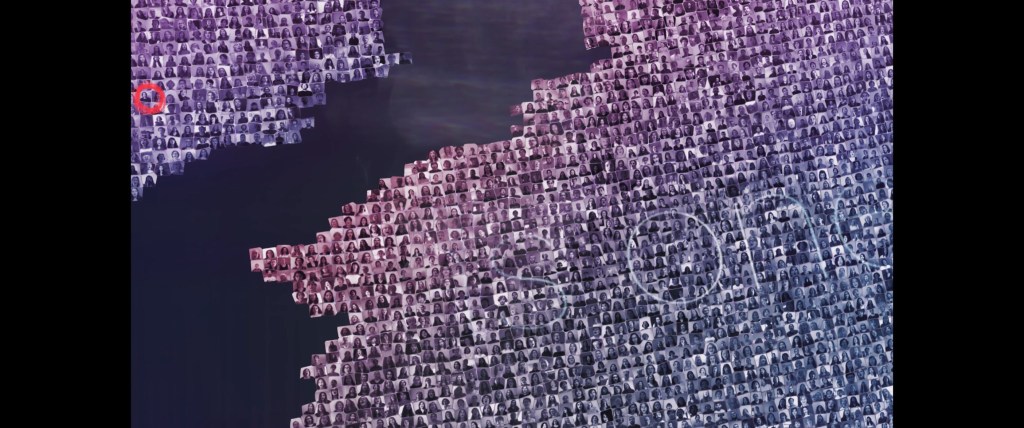
    I was able to find myself in

    USQ Virtual Choir / Band

    Role: Project Convenor, Director, Participant, Editor

    Background

    After watching a video about how Eric Whitacre was inspired by the concept, and thus prepared for his first Virtual Choir (TED, 2011)  and from my own personal experience with collaboration of Eric Whitacre’s Virtual Choirs, I thought it was appropriate to try the process in a setting that would allow for collaboration with different people, and the flexibility of creating either audio or visual material. Initially, I wanted to keep the project within the MUI3005 Course participants, however after reflection of current circumstances posed to all Creative Arts students at the University of Southern Queensland and after consultation with my course lecturer, I decided to offer the opportunity to participate to other collaboration courses within the music field.

    Piece: “It Must Be Love” (Siffre, L. 1981). 

    I chose this piece because it would be familiar to the MUI3005 cohort of students. The point of the project was not to learn new music, but to adapt music performance to a new context.

    Preparation

    I realised early in the process that I needed to be able to place the audio and video in synchronisation with each other, and I needed a mechanism to help participants to achieve that. I decided that incorporating a metronome would aid in keeping parts, and any added instrumental in time of the piece. This will make it easier when inputting into software and syncing all recordings together. 

    Materials

    I later decided that I needed to separate the parts (with the metronome) individuals particularly for participants that are not as familiar to the piece.

    • Backing tracks 
      • All Voices + Metronome
      • Upper Voice + Metronome
      • Middle Voice + Metronome
      • Lower Voice + Metronome
    • Lead Sheet Music (with chords for instrumentalists)
    • Original Sheet Music File (for individual adaptation)
    • Instructions on how to record and submit

    I needed to also assign due dates and a setup for submission of recordings. I needed to consider  the time that I needed to produce a mixed recording (audio or audio-visual). 

    Zoom Meetings – Two meetings were held for potential members, giving them the opportunity to discuss how and what they can contribute. Availability of potential participants was an issue, however I was able to utilise other means of communication to reach out to  the  students of the MUI3005 course.

    Social Media – In order to gain further engagement from the USQ Creative Arts Community, I posted notifications up on the “USQ Bachelor of Creative Arts Collaborations” Facebook page (2020), as well as course forums.

    Lecturer Contact – In order to be able to connect with music students in other courses, I contacted the department lectures through email, and shared my resources so they could pass it on.

    Testing

    I decided early on that I needed to test software capability when compiling multiple audio and video recordings together into a single project. The resulting recording worked well, after some sound level manipulation (as the frequencies were too much for the speakers).

    Reflection

    There were very few submissions (a piano and alto part) to the USQ virtual choir, which has left the project incomplete. This highlights the need for project to attract and maintain engagement of participants. After conversations with members of the group,  found that they had put their own projects as priorities, which is understandable when those projects count towards their assessment. 

    Another point raised was time management. Even though I gave participants a month to get submissions completed and sent-in, they still did not have enough time to do the work, as such time management and commitment to completing the project is a highlighted issue.

    In order to finish this project, I recorded myself singing the three vocal parts in a cappella. I also sound balanced and created the final video (including the background). I did this in order to demonstrate that with available technology, I was able to produce a performance through virtual means. This video was released through YouTube and my social media links.

    A virtual choir of me…”It Must Be Love” Acapella Trio.

    I did some mastering and editing of the intended composition based on the submitted material I had. I later had an admission that one of the members had problems syncing with the metronome and the original recording. This has resulted in the final composition being slightly out of sync in the base part as opposed to the rest of the parts and piano (See USQ VC/Band). 

    References to Media

    • USQ VC/Band: This a video put together from the parts submitted by participants. I used previously recorded of myself to substitute for missing parts which were originally designated to participants that did not contribute in the end product. Rendered and mastered on 2nd June 2020. Not published.
    • USQ VC Final Video: This is the final video that I composited of “It Must Be Love” (Siffre, L. 1981). Recorded, rendered and mastered on 19th May 2020. I published this across my own professional YouTube and other social media platforms

    Brisbane Chorale Virtual Choir

    Background

    During the process of preparing a Virtual Choir / Band opportunity for USQ Creative Arts students, the Executive committee of the Brisbane Chorale approached me about the prospect of setting up a similar experience for its members. 

    Preparation 

    After discussion with conductor Emily Cox, we decided to set up the Virtual Choir around a performance of “Vedi le fosche notturne” or “Anvil Chorus” from Act 2, Scene 1 of ‘Il Trovatore’ (1853) by Giuseppe Verdi.

    I knew that I needed to make the Virtual Choir accessible to members only, and not to the general public. I decided that setting up an independent group on Facebook, and linking the ‘Brisbane Chorale Members’ group, would provide the required accessibility. It is also more likely that members that are already on the platform, would be willing to engage in virtual content. 

    I utilized the ‘Units’ functionality in Facebook groups, creating step by step instructions, and relevant content and resources to contribute to the Virtual Choir project. The group remained open to a few people (Conductor Chorale president, and myself) during the construction. I then opened it up to a small group of people for testing.

    After a few days, it was decided the the piece would be too difficult for members to practice and record, and that a simpler piece would be needed, at least for the first Virtual Choir. It was decided that the piece would be changed to “Ave verum corpus” (1791) by Wolfgang Amadeus Mozart. 

    With the change of piece, I had to edit the content of the ‘Virtual Portal’. Committee members were able to contribute resources in the form of links for this piece, making my job of putting it together online a lot easier.

    I was able to update and edit the Virtual Portal with relevant content.

    Recorded on 16th May 2020 using a screen capture app on my MacBook computer. After reformatting and re-linking resources, the group was opened to a select few of members who worked through the project, and provided feedback about issues that need to be tweaked before the full launch to the general membership.

    Process

    The ‘Brisbane Chorale Virtual Portal’ was opened to a few members who were pre-selected by the conductor and president. The limited release was so I could get some feedback on the process that had been setup and adjust the platform, if needed. It also allowed me to put a beginning model of the virtual choir in Logic Pro X (2019) and Final Cut Pro (2019).

    Given that some members are not members of Facebook, I created a PDF version of the content, so they can participate in the project by using their emails.

    Reflection

    Final Outcome for Brisbane Chorale Virtual Choir – “Ave Verum Corpus” by Mozart

    Positives

    • I have been receiving emails and comments from members, thanking me for setting up the virtual choir, and aiding in providing a place for members to reconnect and perform whilst in isolation. It has been requested that such projects would be offered in the future so those that cannot be present in person, can still do so virtually. Individuals include those who won’t be able to re-join because of age, immunity, and health venerability.
    • This project has allowed the Brisbane Chorale to stand out with virtual capability to include members and audiences outside of the concert arena. 
    • Possible community projects to include members of the general public.

    Negatives

    • By taking on this project, I knew that the workload would be quite large, particularly in the setup, and in the final production of the project. I am fortunate that I know how to put such projects together, but am unable to delegate tasks to other members mainly because the tasks are at a technological level that exceeds the current (known) knowledge base of the Brisbane Chorale membership and organisation. 

    Survival of the Fittest? or of the tech-savvy?

    Points that have been made include;

    • implementing and participating in virtual choirs requires some technological savviness.
    • the understanding of music in multiple parts is very important, especially when selecting pieces to incorporate in virtual choirs. Pieces also need to be constructed in individual parts, synced and mastered to have a balanced performance. 
    • virtual choirs and bands can expose new audiences to groups that would otherwise be restricted to physical performances. Online media platforms are generally free to utilize allowing for greater audience exposure (YouTube, social media, sharing, etc).
    • Engagement to virtual projects are key in collaboration.
    • Management of virtual projects requires are large workload in preparation and mastering. Accommodations also need to be made for participants that do not have the technological know-how.

    In conclusion to this portfolio, I found that virtual choirs are a great method to utilize when keeping music groups together during times of isolation.

    Bibliography

  • The Language of Music. Is it still relevant?

    How does an understanding of the musical languages of the past relate to the world of the contemporary composer/songwriter or performing musician today?

    by Sarah Talbot
    Sarah is a Graduate of the Bachelor of Arts and Science and Postgraduate Diploma of Teaching and Learning programs at The University of Southern Queensland, Australia. She is also currently a student of the Bachelor of Creative Arts (Music) at the same university. Article was originally published as a course assignment. Adapted for online publication on LinkedIn and WordPress.

    Music is a language just like the spoken or written word. It has its own constructions and morphologies. As such it has a history. With the spoken word, a person can use and understand without knowing the roots of Latin or ‘borrowing’ of words. To have a deeper meaning of language, one needs to delve into the roots and origins of matter. This enables a deeper appreciation and preserves the cultural knowledge of the subject matter. It is like-wise for music.

    The following is a discussion and an analysis of how an understanding of musical languages of the past relate to the world of the contemporary composer/songwriter or performing musician today. Using musical pieces from various eras of musical history, this essay will attempt to breakdown music and redefine it into the context of language, and argue that by having knowledge of the past, can assist contemporary music in performance and compositions.

    So what is the music language? 

    The Encyclopaedia Britannica (2018) defines ‘Music’ as an…

    “art concerned with combining vocal or instrumental sounds for beauty of form or emotional expression, usually according to cultural standards of rhythm, melody, and harmony. Music is an art that, in one guise or another, permeates every human society” 

    This is rather a broad definition as music varies depending on cultural context. Greek philosopher and mathematician, Aristotle has said…

    “It is not easy to determine the nature of music or why anyone should have a knowledge of it”  (Britannica Academic, 2018).

    ‘Language’ is also a broad term that is defined based on cultural context. The Oxford English Dictionary (2018) offers several definitions that together can define language for the purpose of this essay. Language is; 

    “The system of spoken or written communication used by a particular country, people, community; a formal system of communication by gesture; The vocabulary or phraseology of a particular sphere, discipline, profession, social group; jargon. A style or method of expression in a non-verbal artistic medium such as music, dance, or the visual arts; A community of people speaking a common language” (Oxford University Press, 2018).

    The study of language, or linguistics, is able to breakdown language into components such as morphology, syntax, semantics and pragmatics. The following is a brief definition of some of these components in relation to general spoken language taken from George Yules’ textbook, Study of Language (2010). This writer will contextualise these definitions in relation to the musical language.

    Morphology is the study of forms, more specifically the elements (or morphemes) that make up the message, which include the adding and subtraction of elements that change tense, person or meaning (Yule, 2010, p. 67). In relation to music, its morphology can include the structure and flow of the sounds (the morphemes). Whether changing key, alternating between major and minor, manipulating the intervals, or changing instrumentation; this can potentially change the overall piece, thus ‘morphing’ the overall message or intention to audiences. A contemporary example of morphing is the changing of minor to major keys of the song ‘In the End’, originally by Linkin Park (Linkin Park Official, 2009),


    https://youtu.be/eVTXPUF4Oz4


    and covered by Gordi (Triple J, 2017).

    https://youtu.be/mPQ7y6ZYPto


    The original piece was set to a minor scale, giving it a sad, depressing feel, coupled with the lyrics and heavy rock instrumentation adding to the ‘hopelessness’ and loss. Gordi’s version changes the piece into a major scale, removing the heavy rock instrumentation and replaces with folk music drones, harp and percussions, with backing vocals, giving the piece a sense of ‘hope’ or ‘struggle’ in a positive light. 

    The understanding of how morphing the scales that stems from knowledge of the ‘Greater Perfect System’, the diatonic and chromatic tetrachords and the Lydian species, originating from Ancient Greece (Burkholder, 2014, pp. 15-17). Whether this knowledge is intentional or not, such elements underlie the effects of manipulation of the piece and conveyed meaning. 

    The next component is the ‘syntax’ which literally means the structure or arrangement of elements. This includes the use of repeated phraseology (Yule, 2010, pp. 96-99). In musical terms, this could be the arrangement of notation, or the arrangement of pieces or movements. Forms of music have existed into the early classical periods of instrumental music.

    The sonata (originating from the Renaissance) and symphony (set by the precedents of Haydn) (Burkholder, 2014, pp. 506-508, 512-516), with the combinations of fast and slow movements, is making a return in the forms of movie and television music. The works of John Williams is an example of contemporary use the symphonic form (Burkholder, 2014, p. 972). In Williams’ pieces, he has often integrated fast and slow movements (or variations), which stays true to both sonata and symphonic forms of classical music. An example is the Superman Suite’ (1978) which incorporates a ‘March’ and a ‘Love Theme’ (Willlams, 2013)

    Orchestra recording music for 'Star Wars' at Abbey Road Studios.

    John Williams is also said to be responsible for the resurgence of the use of the ‘motif’ to illustrate characters, or what the scene is portraying on screen. Beethoven and Wagner were some of the first composers to use motives (or motives). An example would be in Beethovens’ Fifth Symphony (1807-8), with the use of the ‘four-note figure’ (Burkholder, 2014, p. 576). John Williams extends the use of motifs in music such as ‘Jaws (1975), ‘Stars Wars (1977), ‘Superman’ (1978) and ‘Indiana Jones’ (1981). This method has been utilised such as Howard Shore in ‘The Lord of the Rings (2001 – 2003) and ‘The Hobbit (2012 – 2014) trilogies. Most audiences can identify the movie and characters just by the associated musical motive (Schrader, 2016).

    The madrigal and chant in choral music is also fast becoming popular in choirs, particularly in the works of Eric Whitacre. Using influences of polyphonic Gregorian chant, English style madrigals and Mozart’s ‘Requiem’ (Burkholder, 2014, pp. 52, 107-108, 260, 556), he composed music for SATB choirs, and has been one of pioneers in virtual (online) choirs (TED Talk, 2011) and merging contemporary music methods of composition with technology (Eric Whitacre’s Virtual Choir, 2013).  

    Semantics and pragmatics in language refers to the meaning and interpretation of words, phrases and sentences (Yule, 2010, pp. 292, 294). The same goes for music in analysing components, and discerning what the musician; composer, etc. is trying to convey to the audience. 

    The Written Word?

    The written notation of music is just as important in understanding the various components that make up a piece. The notation is the fundamental communicative tool conveying intentions of the composer to the musician. Like the English language, music notation incorporates its own vocabulary, shorthand and gestures; and just like the English language, music has gone through an evolution from ‘Latin’ roots to the contemporary notation that we are aware of today. 

    The Oxford Dictionary of Music defines notation (or nomenclature) as;

     the methods of writing down music so that it can be performed. These are devices for which the human being long felt no need, and much of the world’s music, today and in history, has existed without notation. Systems of notation exist in other cultures, but it has been central to the history and development of European classical music” (Oxford University Press, 2013, p. 603). 

    Example of Gregorian chant manuscript. One of the early forms of written music notation.

    Historically, the earliest forms recorded musical notation comes from Ancient Babylon, and then reappears in the forms of ‘neumes’ in monastic scripts for religious chants. These scripts are no more than guidelines of the gestures used to accomplish the piece. An understanding was needed of the movement of pitch, whether ascending or descending (Burkholder, 2014, pp. 8, 32-38). Notation as we see it today, came about through evolution of ‘neumes’, with the addition of clefs, and key signatures, notes were given values within a period of time, which also gave rise to the time signature. From these seemingly simplistic musical concepts, notation further evolved into complex time signatures, modulations, and incorporations of multiple instruments (which have their own range of notation, shorthand and vocabulary) (Rutherford-Johnson, T. Oxford University Press, 2013). An orchestral score is more complex than a single instrument piece, and the ability to interpret is paramount in communicating intention, from the composer, to the page, to the performer. 

    One only needs to see the differences in scores and notation through time, to understand the building of intricacy; Medieval music was either purely instrumental or choral, very rarely notated together. Notation was simpler and easy to understand. E.g. Perotin’s Viderunt Omnes (Musicnetmaterials, 2016).

    Classical and Romantic composers such as Beethoven, Mozart and Brahms experimented with the use of dynamics and tempo in conveying emotion. The merging of orchestra and choirs also added to intricacies. E.g. “A German Requiem” (1868) (Brahms, 1928)  

    Contemporary composers merge the past forms and notation, and ‘morph’ them into new creative forms, even changing vocabulary and adding non-Western instruments. 

    Why is the knowledge of the musical language of the past, important to musicians today?

    Whilst many musicians claim that they do not read music, they at least have basic concepts of music structure. Like the speaking language, a person can understand the spoken word and interpret meaning, even if they cannot read or write it. Musicians today may already have an unconscious grasp of the musical language.

    The at home digital studio

    Many digital composing and production programs, such as ‘Sibelius’, ‘Finale’ and ‘MuseScore’, have the capacity to set inputted sound to notation for distribution needs. Manuals of such software emphasise that notation is a method of communication between composers, arrangers and producers, to the musicians and performers (Johnson, 2008, p. xvi).

    Music notation has also been used as ciphers, codes and cryptograms. Music has very close associations with mathematics, so composers such as Schumann, Bach and Ravel have used music to hide names and messages within the notation, whether it be a patron, a lover, or political or religious statement, or a dirty joke (Burkholder, 2014, p. 611)(Wikipedia, 2018).

    Knowledge of the musical language is also part of Western historical and cultural heritage. Even if it is not written, knowing the language is part of the process of evolution. A lot of earlier works have been passed verbally before being written down, after which has been stored and reproduced. Globalisation through time has helped spread music in its various forms. Most people would know a piece by Beethoven, or the ‘Star Wars Theme’ by John Williams. 

    Music is now widely available, through online distribution. Musicians can be the professional concert performer to the amateur bedroom producer, but all need a form of communication that unites them all. This form is the musical language.

    The current form of the musical language is globally acknowledged and accepted form of communication for music across cultures, spoken languages and instrumentation. A person in Germany can understand the written form of music if it was written in China or the United States, if they understand the ‘jargon’ associated.

    In conclusion…

    The original question was ‘how does an understanding of the musical languages of the past relate to the world of the contemporary composer/songwriter or performing musician?’ The overall answer is that the musical language is a form of communication, whether it is conscious or unconscious, written, verbal or gestural. 

    An understanding of that language helps to unite the global music community. Unlike spoken languages, music has the ability to reach all global citizens, and beyond. 

    No alt text provided for this image

    Like all languages, music has a simplified version which becomes more complex on closer examination. The contemporary musician can get by remaining on the simplified version, however; the closer examination of music, and its associated language, allows for a more proficient (or articulate) musician or composer.

    Resources for learning Music Theory (language)

    Bibliography

  • Those who know me personally will know that I am a stickler for self-study and improvement…if you are going to teach, you need to learn, right?

    I have officially graduated with a Bachelor of Music with Honours. This builds on my previous degree of Bachelor of Creative Arts (Music).

    It was a bit of a slog, particularly with my final thesis submission, but I got there. My thesis was about the COVID-19 effects on two choirs I have been involved with. I conducted background research surveys, analysed the data, and attempted to compare it to data from around the world and Australia. A task… Most components were built upon the thesis with bibliographies and research proposals. In all, the final dissertation was 71 pages (with appendices of research and a bibliography)….almost a novel…my grandfather would have been proud (being a published author)

    I also rearranged two contemporary pieces into choral arrangements. The recordings attached are blended, with no part standing out as it was the sheet music (not supplied to this blog) that was credited.

    • “Monster” by Imagine Dragons – arranged into male acapella choir
    • “Anti-hero” by Taylor Swift – arranged into female choir with underlying piano part.

    I also attempted to re-arrange “Everglow” by Coldplay and “Fall on Me” by Great Big World, but I found that time-wise, I wouldn’t be able to do either piece justice. At least I have hobby pieces to work on. Sheet music was submitted as the ‘Creative’ component of my Honours degree.

    Anyway, I figured its been a while since I posted, probably should. I know its been a while…Been a bit busy personally, and have had to take some time to look after myself. But I keep on going…

    Until next time…

  • Music Copyright in Australia

    Simplifying Australian Copyright Law for the Musicians and Music Artists.

    What is copyright?

    The Oxford University Online Dictionary defines “Copyright” as “the exclusive right given by law for a certain term of years to an author, composer, designer, or assignee, to print, publish, and sell copies of his original work.” (OED. 2020).

    In Australia, a critical document in legislation outlines the definitions and provisions of the various forms of copyright and the legalities involved in protecting copyright, The Copyright Act of 1968 (Federal Register of Legislation & Australian Government. 2017). The document itself is over 700 pages long. It is justifiable that there is some confusion and contradiction when applying legislation to music industry publications by reading through it. 

    This presentation intends to simplify understanding of the legal rights of publications and performers concerning copyright in the music industry. The reader should note that the research conducted for the following is in the context of Australian law in the years 2020 and 2021. Also, note that some conditions outlined may apply to international entities and international laws.

    History of International Copyright Legislation & its Application in Australia

    Berne Convention

    In 1886, a convention or Treaty was created for the Protection of Literary and Artist property by a congregation of members from various European countries. The “Berne Convention for the Protection of Literary and Artistic Works” was an agreement between international entities to respect and uphold the copyright.

    It states three basic principles;

    1. Works originating from one contracted country must be given the same rights and protections in each of the other contracted countries.
    2. Protection and Rights are given automatically and are not conditional upon any compliance (e.g. additional requirements)
    3. Protections and rights are independent of the existence of the protection in the country of origin unless the protections extended from the country of origin exceeded the minimum requirement of the convention, in which case protections revert to the cessation of the country of origin. (WIPO. 2021

    Following these basic principles, minimum standards were set and enforced as part of the Treaty’s conditions. These standards were revised in the Paris Convention of 1979 to incorporate the evolution and increased access to media.

    • the right to translate 
    • the right to make adaptations and arrangements of the work
    • the right to perform in public
    • the right to recite
    • the right to communicate to the public
    • the right to broadcast
    • the right to make reproductions (subject to intellectual property and sale of the said property)
    • the right to use the work as a basis for an audiovisual work

    (WIPO. 2021

    Australia became a signatory of the Treaty in 1928.

    World Trade Organisation

    (World Trade Organisation, 2016)

    The Berne Convention became the basis for the Agreement on Trade-Related Aspects of Intellectual Property Rights (TRIPS Agreement) of the World Trade Organisation (WTO). TRIPS acknowledges and refers to the Berne Convention expanding upon it to incorporate patents, inventions and digital evolution of technology and media. Articles further identify enforcement of the agreement and disciplinary action enacted by the WTO.(Wikipedia. 2021)

    Regarding Intellectual Property Rights, the agreement further states;

    • Member states must acknowledge end comply with Articles already established in the Bern Convention (1971) and the Paris Convention (1967)
    • Whenever the term of protection of a work is calculated on a basis other than the life of a natural person, such term shall be no less than 50 years from the end of the calendar year of authorized publication or, failing such authorized publication, within 50 years from the making of the work.
    • The term of the protection available under this Agreement to performers and producers of phonograms (recordings) shall last at least until the end of a period of 50 years computed from the end of the calendar year in which the fixation was made or the performance took place or shall last for at least 20 years from the end of the calendar year in which the broadcast took place.

    (WTO. 2021)

    This agreement became a part of the World Trade Organisation legislation, which is agreed to by all members. Australia signed this document at its original inception and implementation in 1995. 

    World Intellectual Property Organisation

    (World Intellectual Property Organisation, 2010)

    The World Intellectual Property Organisation is an agency of the United Nations, established in 1967. (WIPO. 2021) There are currently 193 member countries that ratify the WIPO Convention (Copyright Treaty), which is Australia’s case;

    • a member of the United Nations 
    • A member of either the Paris Union or Berne Union. Australia is a member of both, having signed both conventions (WIPO. 1979)

    The Treaty was enacted and enforced in 2002; however, it was not signed by Australia until 2006. This was because of issues regarding owners’ rights of trademarked goods and patents. Issues identified by WIPO required the Australian Government to amend Federal legislation government copyright concerning patents and trademarks. This involved the removal of legislation, renegotiation, bill delivery and senate approval by Australian government officials and organizations. This further resulted in two Intellectual Property Laws Amendment Acts of 2003 (Parliament of Australia. 2003) and 2006 (Parliament of Australia. 2006)

    After producing and enacting these documents, WIPO granted Australia signatory status to the Copyright Treaty.


    (WIPO. 2016)

    Australian Copyright

    Copyright Act 1968

    So we are back to the Act that started it all, The Copyright Act 1968.

    There are three central governing bodies to look after music copyright and licensing in Australia

    There are also a few organizations that look after the implementation and enforcement of copyright law in Australia

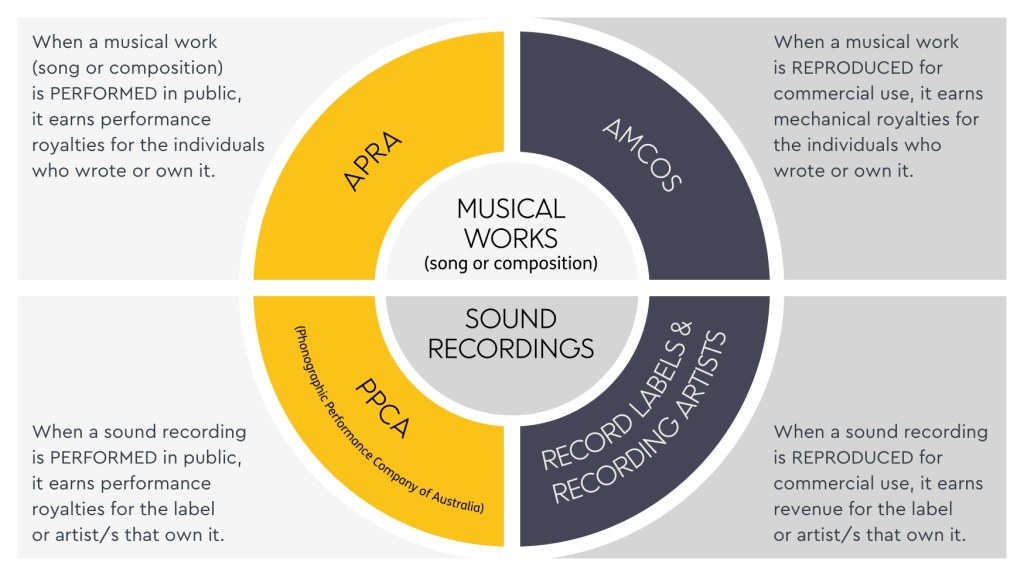
    It is sometimes difficult to determine which organization is responsible for which licenses and protections. APRA AMCOS but together a diagram to help musicians and producers simplify the process of working out which licenses are applicable for each circumstance and whom to contact concerning each license form.

    (APRA AMCOS. 2021)

    APRA AMCOS

    (APRA AMCOS, 2021a)

    The Australian Performing Rights Association (or APRA) was established in 1926 to manage the performing rights of musicians across Australia and New Zealand, assuring that royalties from performances made it to musicians or the owners of the copyrighted work (APRA AMCOS. 2021). 

    The Australasian Mechanical Copyright Owner’s Society (or AMCOS) was established in 1979 to manage the royalties accumulated through commercial use such as media, streaming, and physical sales (such as Vinyl and CDs). It also covers the reproduction of the work. Both organizations merged in 2019 to form APRA AMCOS after collaborating in providing services to Australian artists since 1997.

    (APRA AMCOS. 2016)

    Copyright in music can be split into two main strands.

    Master Rights is the ownership of the original material or recording. For example, you have composed an original song with lyrics and instrumentation; you have the only copy of the recording and sheet music. Another person cannot legally play it unless you permit them to (Ditto Music. 2020). 

    This is the central role that APRA occupies regarding music registration and the primary contact point for musicians seeking copyright permissions. Registration also enforces copyright for that piece, granting a serial number or ISRC and permission to use (c) symbol in any future publication (or reproduction) of your work.

    Composition Rights is the right to reproduce the ‘Master’ to sell to other parties for commercial use. Mechanical Royalties are the result of this process. These are monies obtained through licensing or the number of ‘plays’ on various platforms (Ditto Music. 2021). 

    Referring to our previous example of owning the original song, composition rights become essential when publishing your music on an audio streaming platform (such as iTunes or Spotify). You are then entitled to mechanical royalties based on the number of ‘plays’ on each platform. This also includes work on TV and radio, where the copyright owner is paid royalties every time the song is heard. It is likewise the same for selling sheet music online, based on the number of reproductions or sales.

    AMCOS is responsible for artists’ compositional rights and distribution of mechanical royalties. Since artists should register their work before publishing, both bodies determined that it would make sense for APRA and AMCOS to combine.

    It is free to register with APRA AMCOS, just as it is also free to register your original works. You can access the site below to begin the process.

    https://www.apraamcos.com.au

    PPCA

    (The Phonographic Performance Company of Australia, 2021)

    The Phonographic Performance Company of Australia (or PPCA) was established in 1969. They look after licenses and fees for copyrighter holders whose music features in broadcasts, communication and public playing of music (including downloading and streaming) (PPCA. 2021). When work is performed in public, this accrues performance royalties, similar to mechanical royalties.

    For Example; A band has been granted permission by the PPCA to perform your song at a series of pub gigs whilst on tour. Every time they play your music publicly, they are required to pay a fee. This fee is then distributed between yourself (as the master copyright owner), the record label (if you are signed to one), and the PPCA (covering legal and administration fees).

    It is suggested that when registering with APRA AMCOS, music artists should register with PPCA as well. PPCA has a FAQ section that can assist artists in deciding how they should register (as an artist, creator, or licensor) (PPCA. 2021). More information can be found on the websites below.


    As a musician…What Can or Can’t I do?

    Copyright can be a landmine field. You are alright as long as you do not step on one. Like most laws in Australia, they are often tied up with additional clauses that we don’t tend to read or acknowledge. This is often the downfall of many music artists. This is not to deter but to instead inform and make aware that a sentence on a page usually has additional meanings. The following are some legal definitions and examples of how music works that can vary from Australian law.

    Public Domain

    Public domain is defined as “The state or condition of belonging or being generally available to all, especially through not being subject to copyright” (OED. 2021).

    Regarding music in its forms, a work can fall into the ‘public domain’ under the following conditions.

    For musical works and lyrics, copyright has expired if the creator died before 1 January 1955 and the material was published during his or her lifetime. If not, then the general rule for musical works and lyrics is that copyright lasts for the life of the creator plus 70 years.

    For sound recordings, copyright has expired in any recording made before 1 January 1955. If not, then the general rule for sound recordings made after 1955 is protected for 70 years after the year in which it is first published. 

    (Australian Copyright Council. 2019)

    Copyright, after expiry, is not renewable and instantly falls into the category of ‘public domain’. 

    Most classical works would automatically fall into the public domain and be readily used in new creative works. This is why classical music is often utilised in movies and television as backing tracks on sync. There is little to no licensing contracts and fees to be dealt with.

    It is best to check with APRA AMCOS regarding Australian recordings, and publishing studios overseas, before using works falling into the 70 years after the artists’ death, as particular conditions such as legacies and overseas law can affect copyright duration.

    FCASE STUDY: Elvis Presley.

    • Died in 1977 (does not fall with “creator dying before 1955”)
    • His early works were published in the 1940s and 1950s (such as “That’s All Right” (1946)). Copyright law would indicate that such works would technically fall into the public domain for the “70 years after publication date”.

    There is a catch; the United States has an additional law stating that works published during this time are entitled to 95 years of copyright protection (even after the artists’ death). In the United States, the likes of “That’s All Right” would not fall into the public domain until 2048. (Cornell University Library. 2021).

    For Australia; the acknowledgement of Berne Convention Principle 3 

    Protections and rights are independent of the existence of the protection in the country of origin unless the protections extended from the country of origin exceeded the minimum requirement of the convention, in which case protections revert to the cessation of the country of origin.

    Australia, therefore, must abide by the ruling of the country of origin being the United States, meaning that Australia cannot term Elvis Presley’s works as public domain until 2048.

    This case is only one of many where copyright law can be fluid between countries. Therefore, it is essential to determine the ‘public domain’ in each country of origin.

    Performance & Publications

    Original Music / Works

    Any works produced as original by creators are automatically covered by copyright. It is highly suggested that an artist registers their work with APRA AMCOS and PPCA to protect their copyright rights and obtain any fees obtained when using their works, whether by themselves or by other artists.

    Covers

    Covers are great to showcase talent online, but you cannot profit from these recordings. Be prepared to pay for the privilege to use other artists’ work if you should choose. It is the same for live performances as well as recordings. Permissions can be obtained through Recording Studios or applied through AMCOS or PPCA.

    Some online platforms and forums will allow you to publish videos and samples of music on the condition that you do not charge a fee to those who view or listen to the cover version. YouTube has a policy that allows musicians to publish cover content; however, it reserves the right to either block audio or ‘take down the content at the request of the owners of the original piece (Youtube Creators. 2020). 

    In most circumstances, if the cover music is published for free and acknowledges the original composer/writers of the piece, it puts them in good stead with Youtube. It should be noted; however, YouTube has a strike system in place for copyright infringement. The first strike is a warning; the second strike will result in suspended accounts (and perhaps account deletion).

    Youtube Creators. (2020, May 19).

    For example; YouTube and Smule

    Smule is available for small device and some smart televisions. There is a free version, and subscription version which gives access to additional features. Access link: https://www.smule.com

    As a musician, I have dabbled in covers, whether for fun or educational uses (singing lessons, research, practice, etc.). I have used the platform Smule for nearly ten years. Smule is a mini recording studio using backing tracks and recording vocals. Professional artists have used it to connect to fans, often recording duets for fans to participate in. 

    After recording audio or video, there is an option to publish (or share) on social media platforms, including Twitter, Facebook and YouTube. Artists should note that the Smule logo and branding are incorporated into the publication by publishing the cover. This is a form of copyright permission, identifying that a cover artist recorded the piece within the platform of Smule. 

    As mentioned before, YouTube can determine with videos contain copyrighted audio. The user (upload) will receive a nice through email or the ‘YouTube’ Studio, notifying that their video contains copyrighted material; and informs you of the actions required or have already been undertaken in copyright protection of content.

    Smule Inc. (2017)

    A video example of me singing with Ed Sheeran in ‘Castle on the Hill’ (Smule Inc. 2017). It was used as an ‘April Fools’ joke, as I posted this on my social media platforms. The video incorporates elements that help identify that material and the source from which it came, including subtitles and the ‘Smule’ logo in the bottom right corner. This indicates that I created this video under the terms of copyrighted stipulated by the Smule Copyright and legislative policy, more easily known as the ‘Terms of Use’ (Smule Inc. 2020).

    Smule is an internationally utilised platform; however, it operates under the copyright regulation and legislation of the United States.

    Sheet Music (Print / Digital)
    Access Link: https://smppress.sheetmusicplus.com

    Sheet music is often a replication or a rearrangement of a sound recording; as such, copyright ownership belongs to the owners and creators of the original piece unless the piece falls into the conditions aforementioned about the age of the piece or whether it is within Creative Commons and public domain.

    Online media platforms have ventured into allowing potential arrangers to publish their arrangements online. Permissions for arrangement creation are obtained through these online platforms and publicised to the arranger community. When arrangements are published on that platform, copyright protection is monitored and enforced by that platform’s copyright policy. 

    It is sometimes allowed that an arranger may obtain a portion (or percentage) of any sales made of the arrangement. This portion is determined by the conditions agreed upon between the original copyright holders and the publishing platform. 

    The rest is allocated to the services of the publishing platform and the original creators. Essentially platforms practice a fair trade agreement between arranger, creator, publishing house and consumer, thereby enforcing copyright for all parties involved.

    SMP Press is an example of a publishing platform. A subsidiary of SheetMusicPlus.com (2021), an online sheet music store, SMP Press allows independent arrangers and composers to publish sheet music under copyright laws of various countries, with the permission of most publishing houses they represent. The availability of arranging copyrighted material is quite extensive because of the extent of their catalogue, from Ed Sheeran to Elvis Presley. 

    They mention that any copyrighted material must be acknowledged in the publication (usually in a copyright statement). Any sales are also divided by percentage between the arranger and original publishing house (plus a commission for SMP Press).

    Concerning the public domain, SMP Press will default to the most prolonged duration of copyright protection (For example, in the Elvis Presley case mentioned in the ‘Public Domain’ section). However, if the publishing house responsible for the work has permitted SMP Press to allow arrangement publication, arrangements can be published and sold on the Sheet Music Plus website, with a portion of the sales going to the original copyright owner. 

    SMP Press also covers works that are within the copyright laws;

    CASE STUDY: Ed Sheeran “Shivers”

    First Released: 10th September 2021.

    Publishing houses and recordings studios (Atlantic, Sony Music) have allowed arrangements to be made for this work, whether instrumental or choral. The condition is that the published sheet music must have the following information at the bottom of each page (the footer)

    Copyright © 2021 Sony Music Publishing (UK) Limited, Sony Music Publishing LLC and Rokstone Music All Rights on behalf of Sony Music Publishing (UK) and Sony Music Publishing LLC Limited Administered by Sony Music Publishing LLC, 424 Church Street, Suite 1200, Nashville, TN 37219 All Rights on behalf of Rokstone Music Administered by Universal – PolyGram International Publishing, Inc. International Copyright Secured All Rights Reserved.

    SMP Press’s method (assuming that arrangers stick to the conditions dictated) covers arrangers. It allows for the allocation of royalties to be distributed among the original creators and the arranger under United States copyright law.

    Once again, the arranger needs to be aware of the ramifications of publishing in the United States, including the need to register for royalties/ income obtained from the United States (Australian Taxation Office. 2021).
    Arrangements (Audio & Visual)

    Audio and Visual Arrangement of original work becomes a little more complicated as it becomes a crossover of copyright ownership between the original owners of the original content and the owners of the arrangement or ‘new version” of the piece.

    It is difficult and costly for an independent musician to publish a performed arrangement unless other parties are involved or have much money already available for purchasing rights to arrange. Contracting representatives would have distributed any revenue made due to the publication of arrangements to relevant parties on agreed terms.

    CASE STUDY: Gordi, Linkin Park, & Triple J 

    (Linkin Park [Linkin Park], 2009)

    In 2000, Linkin Park released “In The End” as part of their debut album “Hybrid Theory” (Linkin Park. 2000). This piece thrust the band into worldwide popularity. They were able to produce a further six albums before the death of their lead singer, Chester Bennington, in 2017. 

    There was a public outpouring of grief, particularly in the music industry. Many musicians produced their arrangements of music initially produced by Linkin Park. Australian folktronica singer Sophie Payten, known as Gordi, arranged a mellowed version of “In The End” in honour of Chester Bennington’s passing. This arrangement was performed and recorded on “Triple J’s Like A Version” radio and vlog programme (2017).

    (Triple J [Triple J “Like a Version”], 2017)

    Under the copyright agreements made between Gordi and Linkin Park (or their representatives therein), Gordi could broadcast and publish her arrangement on social media platforms but could not publish under her name on further albums. This is an example of how certain conditions can be allowed within certain spheres of publication and broadcasting.

    Phonograms (Digital/Streaming)/ Audio Recordings

    There are multiple streaming services available for streaming original content. Many stipulate the country in which laws they follow. Services such as Apple Music (Apple, 2021), Spotify (Spotify AB. 2021), and Amazon Music (Amazon, 2021) follow and refer to the ruling of the United States as far as intellectual property. However, if you read through the contract that Artists ‘digitally’ agree to, there is a stipulation regarding International artists and the Berne Convention. Be aware of the distribution company you choose to use, whether it is by a digital platform such as CD Baby (2021) and Distrokid (2021) or ‘bricks-and-mortar’ such as Warner Music (2021)
    Distribution agreements may include a stipulation that they would own part of the copyright due to the services rendered to the artists. They would be entitled to a portion of any earnings made by the recording, user conditions stated in the agreements made, or by general copyright law. It is best to consider what services they offer and whether it is worth a share in the copyright of your work.

    What if I create music at my University and wish to share or distribute it?

    There are a few options available for musical works created in University environments, but it is highly suggested that you seek advice from a Copyright Officer or Librarian. There is a contact list available through the link below. Alternatively, you can contact Copyright Australia for advice.

    Universities Australia – Copyright Officers Contacts

    Music Copyright in Universities

    Educational institutions, including universities, have a special license agreed upon by APRA AMCOS and the PPCA. It is pretty broad in scope allowing for uses that would not usually be allowed under a standard license.

    Main points

    Playing or performing live or recorded music:

    • At university events (including graduation ceremonies) where the ticket price does not exceed $40
    • As background music in university spaces and businesses that are 100% owned by the university or an affiliated institution
    • By student unions, associations, guilds and clubs that are 100% owned by the university, so long as those activities are permitted within the agreement
    • For educational purposes (such as demonstrations, workshops and lectures)

    Making audio and video recordings that capture live and recorded music:

    • Of university events and graduations
    • To live stream university events and performances on the university’s website and official social media channels
    • To use for university purposes, including in a course of instruction or for engaging with the university community
    • By synchronising music with unrelated visual elements in post-production, ie: incorporating recorded music into another unrelated visual work*
    • To be shared on the university’s website or learning management system

    Print or Sheet Music

    • Reproduce print music, lyrics and tablature in physical or digital formats for use by students and staff for educational purposes or performance at a university event. 
    • Share digital and physical copies with students and staff

    (APRA AMCOS & PPCA. 2021)

    There may be other conditions that the university has that you will need to check. It is best to contact the campus copyright office to get the specifics of the agreement that is in place.

    Primary and secondary schools are also bound by similar agreements regarding using and performing music in educational contexts. Once again, if you are working at a school, you should familiarise yourself with the copyright agreement that the school should have in place (APRA AMCOS. 2021).

    Original Works

    Any original work produced during a student’s study at a university is usually the students’ work, and that student retains such copyright.

    CASE STUDY: The University of Southern Queensland Query

    As part of the research for this presentation, I sent an email to the University of Southern Queensland Legal Office outlining the scenario of creating original work in the university setting and who is entitled to the copyright therein. I received a reply from the Legal office outlining the current policy of Original Works produced at USQ.

    Email to USQ Legal Office:

    I am seeking information regarding copyright of music in audio, digital and print. I am creating a document as part of my Bachelor of Creative Arts Project to help Music Artists understand copyright and how it applies to them (what are their right, etc).

    I wanted to ask when sharing work, who actually is the copyright owner? I can give an example.

    I created an original song, using no additional sources (sampling, copying). I use this as part of an assessment item at USQ. Do I still retain copyright ownership being the creator? Or does the university own it because of academic copyright? 

    I am a published music artist, but would like to be able to release my content after graduation (audio and sheet music). I have already set up an agreement through third party (SMP Press) to publish my sheet music. Audio I would release as an independent artists through music streaming platforms and YouTube.

    (Talbot. S. 2021. Copyright for Music publication [Email])

    Reply:

    As per the USQ Intellectual Property Policy (https://policy.usq.edu.au/documents/13345PL#5.8 ) the University makes no automatic claim to ownership of Intellectual Property created independently by Students who are not Employees of the University.

    If you are not employed by the University to create this work, you retain the copyright to this original work.

    Copyright Law regarding musical works often relates to separate items of copyright that are combined to form the whole work. For example, the sheet music, sound, lyrics, etc. With regard to your example, you have advised that you have entered into an agreement with a third party (SMP Press) for the sheet music and thus you would need to look at that agreement to see whether you have retained your copyrights or whether you have signed these over in whole or in part. 

    If you were to enter into any agreements with other platforms to publish your work e.g. streaming services or YouTube, you would again need to look at the licensing agreements or contracts associated with these platforms. This would also be the case for hard copy publishing of your work.

    (McKindley, E. 2021. Copyright for Music publication [Email])

    Creative Commons

    Creative Commons is an international organisation that operates as an entity that allows for some aspects of copyright to be waived.

    (Wikimedia Foundation. 2017)

    Every time a work is created, it is automatically protected by copyright. In Creative Commons (or CC), creators can distribute content for free and allow others to use the content for their creative projects. 

    Many familiar platforms that operate under the Creative Commons license. You would be familiar with;

    • YouTube
    • SoundCloud
    • BandCamp
    • MusicBrainz
    • Vimeo

    There are many others that you can locate through searches.

    There are six forms of CC licenses, each with different combinations of elements for use. The four elements are;

    • Attribution (BY) – You must credit the creator, the title and the license that the work is under.
    • Non-commercial (NC) – Van be used for file sharing, educational use and festivals; however cannot be used for advertising and for-profit purposes. Basically, you cannot make money from the content.
    • No Derivative Works (ND)- You cannot change the original work (cropping, editing or using music in a film). Remixing is not allowed. You need to seek additional permission if you wish to do any of these activities to work shared.
    • Share Alike (SA) – Any new work produced using materials must be made available under the same terms of the license.

    (What are the Creative Commons licences? 2009)

    A flow chart illustrated below can be used to decide which license is appropriate for the conditions you wish to impose on the content you share.

    There are several factsheets that provide elaborate descriptions available on the Creative Commons Australia or Creative Commons International websites. A license tool also allows you to answer a few questions about what you intend to do with the content;it generates a code that can then be added to your content or added to websites. Once these license have been made public with your content, your content is covered by the (CC) license conditions that you have stipulated.

    Although Creative Commons cannot be used for monetary value, many artists have used Creative Commons to promote their works. Even though access is free to everyone, the resulting publicity has allowed many to build a following.

    CASE STUDY: Nine Inch Nails (NIN) – The Slip

    In 2008, the band released their seventh album, “The Slip”, online under Creative Commons, allowing for mass distribution in a short amount of time. Publicity was sparked when it was discovered that the music was available for free under the Creative Commons license chosen, as long as it was not shared or illegally downloaded. Any remixes made from the content also feel under the same conditions, so creators could not make money from NIN content.

    The worldwide publicity that the band garnered from this manoeuvre allowed them to promote their upcoming international tour of ‘The Slip’ and their previous album ‘Ghosts I-IV’ (also under Creative Commons license).(Creative Commons.Org. 2012)

    To highlight the reputation of Trent Reznor and Atticus Ross, after the release of the album, they were both asked to contribute music both as a band and original compositions to the film “Social Network” (2011). Their contribution was further acknowledged worldwide, winning Golden Globes and Academy Awards for Best Composition.

    Bibliography


    Music Copyright in Australia © 2021 by  Sarah Talbot is licensed under CC BY 4.0 

    Music Copyright in Australia © 2021 by  Sarah Talbot is licensed under Attribution 4.0 International. To view a copy of this license, visit http://creativecommons.org/licenses/by/4.0/Music Copyright in Australia © 2021 by  Sarah Talbot is licensed under Attribution 4.0 International 

    About the Author

    This document was created by Sarah Talbot, a Creative Arts (Music) student at The University of Southern Queensland, Toowoomba, Australia.

    The research was conducted and published as part of the final project-based assessment for the Bachelor of Creative Arts degree (2021). The outcome of this project (being this document) was published under Creative Commons License with the permission of the University of Southern Queensland.

  • I finally graduated as a musician. As of the 21st of December 2021, I graduated with a Bachelor of Creative Arts, specializing in Music. It has been quite an experience adding to the knowledge I’ve obtained from my life, building upon the ones and concepts learnt from Primary school.

    I learnt a lot about elements and got to demonstrate new skills. Since I haven’t posted for a while, I thought I might share a few projects and samples that I was involved in or created. I suppose this post is a portfolio of the work that I undertook during my degree.

    Live Performances

    A requirement of the degree was that I needed to perform both live and recorded, throughout the 4 years that I completed this degree I performed a number of contemporary songs. Given that I had a large experience in classical and choral works, I thought that diverging into other genres would be interesting.

    I’ve included some of the performances that I submitted for assessment, in the Youtube playlist below. The entire list of songs that I performed both live and recorded were;

    • “As Time Goes By” from Casablanca (H. Hupfield, 1931)
    • “I Have Confidence” from The Sound of Music (R. Rodgers, Hammerstein, O., 1964).
    • “I See Fire” from The Hobbit – The Desolation of Smaug. (E. Sheeran. 2013)
    • “I Will Always Love You” from The Bodyguard, performed by Whitney Houston and Dolly Parton (D. Parton. 1992)  
    • “Requiem” from Dear Evan Hansen (B. Pasek & J. Paul, 2017)
    • “They Just Keep Moving the Line” from Smash (M. Shaiman & S. Whitman, 2013)  
    • “Till I Hear You Sing” from Love Never Dies (A. Lloyd Webber & G. Slater, 2010)  
    • “Can’t Fight the Moonlight” performed by LeAnn Rimes (Diane. Warren & Rimes, 2000).
    • “Heaven Help My Heart” performed by Tina Arena (Arena, Tyson, & McTaggart, 1995).
    • “How Do I Live?” performed by Trisha Yearwood (Dianne. Warren & Yearwood, 1997).
    • “I Don’t Know What I’d Do Without You” from A Gentlemen’s Guide to Love and Murder (Lutvak, 2012)
    • “On a Night Like This” performed by Kylie Minogue (Torch, Stack, Taylor, & Rawling, 2000)
    • “Something Wonderful” from The King and I (R. Rodgers, . Hammerstein, O., 1951)
    • “Somewhere” from West Side Story (Bernstein, 1957)
    • “This Kiss” performed by Faith Hill (Roboff et al., 1998).
    • “Wishing You Were Somehow Here Again” from The Phantom of the Opera (A. Lloyd Webber, Hart, Charles., Stilgoe, Richard., 1986).
    • “With One Look” from Sunset Boulevard (A. Lloyd Webber, Black, Don., Hampton, Christopher., 1993)
    • “You’ll Never Walk Alone” from Carousel (R. Rodgers, Hammerstein, O., 1945).
    • “You’ve Got a Way” performed by Shania Twain (Lange & Twain, 1997).
    “Hooked On A Feeling” Performance (2019)

    I was also involved in a live performance of music around ‘The Evolution of Love’. Music incorporated various genres including classical and foreign language. I sang several solos, supplied backing vocals, played the cello, keyboard and synthesiser, and performed the in acapella choral and group pieces.

    Original Music by Labi Siffre. (1981). Stiff Records. London, United Kingdom. Acapellla Arrangement by Helen Russell (2019)

    Recording – Covers

    Given that the pandemic of COVID-19 had just hit the world, and the Performing Arts venues and opportunities closed and disappeared. I decided to investigate aspects of virtual collaboration of music, with choirs. It tried to encourage the public to join in my projects, but eventually It got down to me recording myself doing the various parts and then compiling them together using video editing software.

    I did a sound only virtual collaboration for ‘Okay’ by the Piano Guys. Unfortunately the sound balancing present an issue. I did present it as an assessment item, however did not publish it formally.

    Performance Credits: Lead Vocals – Sarah Talbot
    BVs & Instruments – Brittania Clifford-Pugh, Emma Erdis, Joseph Morgan, Leah Lever, Megan Obrien & Grace Twidale

    Original Song “Grace” (We All Try) performed by Rag ‘n’ Bone Man Graham, Rory., Cox, Fred., & Aldred, Simon. (c) 2017. Columbia Records. London, United Kingdom.

    Another of our assessment items was to produce a cover of a song using involving the member s of the class. My project was “Grace”, one of my favourites by Rag’n’Bone Man. I developed the recording resources and studio plan, so I could direct the participants in recording the final mix.

    I also got to collaborate on other covers with other members of the class taking the lead with planning and studio phases. I supplied the backing vocals and some instrumental for the other covers;

    • “Wasn’t It Good” Cover. Originally performed by Tina Arena (Arena, Tyson, & McTaggart, 1995)
    • “Love Story” Cover. Originally performed by Taylor Swift (T. Swift. 2008)
    • “Walkin’ on the Sun” Cover. Originally performed by Smashmouth (G. Camp. 1997)
    • “Not Alone” (Original Composition. 2019)
    Brisbane Anthem – Original Composition

    Arranging / Mixing

    I did mixing of content already published and some original work a well. I made an omage to Chester Beddington (lead singer of Linkin Park), by remixing elements of lyrics from various songs, and incorporating my on interpretation in of backing using electronic instruments I had available on my software. I called it ‘Shadows‘.

    One of my assessment was also to create an original mix of familiar melody and then remix it again into a incarnation, however still be familiar. At the time of this assignment, it had just been announced that the city of Brisbane would hosting the 2032 Olympic and Paralympic Games.

    I also remembered back in 2012 when Barack Obama (the then President of the United States) made a visit to Brisbane and delivered a speech to students, and academia, which was also broadcasted nationally from the University of Queensland (St Lucia campus).

    Brisbane Anthem – Featuring Australian National Anthem and Waltzing Matilda.

    I took certain parts of the speech and looped it through the original mix and remixes. I submitted three versions (maybe a little overkill…maybe?)

    Composition Sync Only
    • Brisbane Anthem – Featuring The Australian National Anthem
    • Brisbane Anthem – Featuring Australian National Anthem and Waltzing Matilda.
    • Brisbane Anthem – Original Composition

    Sync

    Sync recording and composing is its own beast, given that the original material that is to match theme and emotions has already been created and edited (hopefully) through video and animation. Basically, it is creating a musical and audio soundtrack for visual material.

    I had two opportunites to work with the same material, once as a straight music composer and once as a foley (sound effects, or SFX… if you will) and composer. I basically remastered and remixed the original content that I did in the original project and added the foley layers into the scene. Hence the shorter video in the second opportunity (I only focued on the second scene)

    Foley Add-in, Composition Remaster

    Research

    I also undertook as research project. I had had problem clarification where a musican sits as far as copyright in the various aspects of a musicans (or an artists) field. Utilitsing materials based in Australian an International Law, I was able to piece together a presentation. TO BE PUBLISHED IN LATER POST.

    Stay posted intrepid readers… 🙂 And Happy New Year to you all.

  • Ring out the bells, 2020 has passed on. A new year.

    Unlike last January in Australia, we are not coping with fires, floods, pandemics, and hardship…well not as bad anyway. Music can be now played in most venues, one can go out to a restaurant, and travel domestically at least. Having attempted a holiday at the end of last year, we had to endure a week of crappy weather, before having to make a dash to the state border (Queensland and New South Wales), because of an outbreak in Sydney.

    Boredom as a musician had well and truly set in with most of the 2020 season been cancelled. Brisbane Chorale was fortunate too get in a concert series of Brahms. It was recorded thankfully.

    Now that 2021 has rolled around, and restrictions have eased, many organisations seem to be programming events to make up for the lost season of 2020. If Brisbane Chorale concert diary anything to go by, we are in for a rocket of a season.

    I have just spent the last 2 hours, updating my calendars on Facebook, and this website, inputting dates, times, venues, and additional info (if it confirmed to go). See Upcoming Events & Performances page.

    Guess, its time to pull out the music folder, dust off the croaky voice and get my ass back into practicing and strengthening vocally. It is going to be a doozy of a year barring any further disruptions.

  • The Australian Old Jingle, Remade.

    I’ve been trolling the Youtube looking for inspiration for my next post, and came across an old favourite with a new spin. I was amazed by the response of audiences and crowds when they identified this theme.

    The ABC News Theme (Australian Broadcasting Corporation) was originally composed in 1985 by Tony Ansell and Peter Wall, to be used for the daily news bulletin broadcasted nationally. The theme became a staple of Australian television jingles in that its familiarity is easily identifiable but those who got to listen to it during its run from 1985 to 2005, after which the news them was replaced.

    Original ABC News Theme

    After it was ‘retired’ from broadcasts, it was thought to have been consigned to the historical annals that made up Australian TV history. but low and behold, there are a few musicians that decided the this particular piece is capable of being so much more…

    In 2011, Pendulum created remix, utilising original track, synthesiser, drum kit and bass. The unique aspects is that they also integrated an electronica component into piece, making it more appealing to night club crowds. You can can watch crowds respond when they identify not only the original piece, but the new components that also brings new energy.

    In 2017, LaBoum performed a remix of the ABC News theme of their own, utilising the original track, assisted by a trumpet, drum kit, bass and synthesiser keyboard. Although not attracting a raucous crowd, it did gain attention given that is was performed at an awards ceremony. The use of the trumpet created nostalgia in the piece, and breathed life into a piece that would have been only seen (and heard) through TV).

    Given that this piece is no longer in broadcast with the ABC (or any other TV channel in Australia), it amazes me how well integrated and identifiable a piece that is typically played for 30 seconds each week night, is so ingrained in the consciousness of minds. The recognition of its original material and its potential to be morphed into something contemporary is also astounding, in that it is brought to the attention to the next generation of listeners, who will not have the benefit of listening to this theme on TV, as we have in the past.

    Sometimes, the classics need a breathe of life of the broadcast waves to be remembered… all Australians living between 1985 to 2005 would remember hearing this at some point…just like the “Vegemite Song”. It can almost be said that we identify the ABC Theme…and the Vegemite Song, better then we do our own national anthem.

    Good News Week (2008) “Scaring International Guest with “Vegemite Song”

    Music that is ingrained in Australian conscious is not to be trifled with, especially when the international music industry considers us to be a major centre for music production and promotion…why else would they send many major artist, musicians, bands, etc for concerts here?

    Yes, we are have our own international artists such as Delta Goodrem, Guy Sebastian, John Farnham, ACDC…list goes on, but we must not forget the smaller songs that make up our pop culture and media industry through history. Giving an old them new life allows its legacy as a jingle, and small piece to live on in memories of generations before and for those to come.

    The challenge is then laid… who (or what) will be added to Australia pop culture in the form of jingles, ingrained in society?

  • Music in Isolation

    As I write this post, the restrictions imposed on society in Australia are being relaxed, and we are able to venture outside into the sunlight. It has been a tumultuous year, and it is not likely that it will be ever forgotten.

    A side effect of isolation and restrictions has given rise to the occurrence of depression and anxiety. I, myself, am no exception. With the forced cancellations of performances, with further restrictions on singing and choirs (due to the nature of the COVID-19 virus spreading faster when airborne), I have seen my social life pretty much disappear, and question others to when or how the world can go back to some normalcy (highly unlikely)

    The virtual world has also gotten a kick into the 21st century with many aspects of technology moving to provide access to people, the ability to work from home, online schooling, and up-to-date information. Using these technologies, as was able to keep myself busy…even in the little box of a studio / office.

    Sound Surfing on Spotify

    Found some good stuff by browsing the Spotify. I have quite eclectic tastes and like all sorts of music. I found upbeat stuff to keep energy going, and danced around the house…like no one was watching. I found some calming stuff to help go to sleep during those long periods of lying in bed, staring up at the ceiling. Old stuff, new stuff, weird stuff…One of my favourite finds was “Fall on Me” sung by Matteo and Andre Botticelli. I like the swaying motion that the music has, and the lyrics are quite touching, and resounding to me.

    Reading

    Having time at home allowed me to do some reading. I’m wanting to do more composing and sound mixing. Thought it was high time to delve into the music ‘biz’ and get some insight into operations. I’ve dabbled with the production and recording software, but really want to get into the ‘nitty-gritty’. So my reading list…

    Virtual Projects

    Craving the need to make music with others, I went searching for virtual choirs and bands. Eric Whitacre had launched Virtual Choir 6 in response to the isolation around the world, so I jumped on that bandwagon. I also created a few virtual opportunities for various organisations that I am connected with. Even made my own virtual choir.

    Social Media Goddess

    Before the pandemic, I managed the social media aspects for Brisbane Chorale ( A choral group whom I volunteer). The cancellations of the 2020 season and isolation, made maintaining social media content for not only members but the the general public. Trying to keep music groups in the eye of audiences when there are no performances is not an easy feat.

    Arrange and Publish Music

    I recently discovered SMP Press, an online entity that allows people to arrange and publish sheet music. They also hold licenses to already published songs, which musicians can then arrange for groups, solos…basically whatever context they want. This is a great way to keep the music / score reading and writing skills sharp.

    See? Just a few ways to keep busy during a pandemic…

  • A Musicians Toolkit

    I have been a musician and chorister for nearly 30 years, and I have developed quite a utility bag of tools that I use when prepping, rehearsing and performing various repertoire. Some are essential for what I do (singing). Others not so much, but they do come in handy when I have them.

    If you don’t have a pencil, you don’t have a plan.

    1. Pencil

    Every musicians best friend. I tend to use mechanical pencils (or pacers). It saves on having to sharpen your pencil when the nib gets blunt. Also helps with storage having the clip on the side. I either put it in my music folder, or use it as a hair ornament (out of the way, but easy to get to).

    2. Smart Phone

    These days its kind of a ‘must’ to have a phone, but my phone has a few apps that not the ‘everyday Joe’ would have.

    • Metronome – Used for preparing repertoire, so I have a rough idea how fast a piece may go. The conductor will usually opt to go slower before picking up the speed during rehearsals, but I like knowing wha the end goal potentially could be. I also use it as a beat guide for complicated rhythms.
    • Mini-piano – It’s not the best solution for tuning issues, but it does work in a clinch. It’s hard to play full phrases with keys the size of my pinky finger, but for one note tuning, it works fine.
    • Voice Recorder – I sometimes record during rehearsals so I can learn the piece. I like to get as much ‘off-book’ as possible.
    • Spotify – I use this quite frequently, obviously for listening to music. Most people would have a music streaming service on their phones. I also use it to study up on repertoire by listening to previous recordings.

    3. Ipad

    Another piece of ‘must-have’ technology. It keeps me mobile without carrying around loads of books and paper. It is also my personal and professional organiser.

    • Digital Music – Sometimes its easier to have everything stored in a cloud, and then access it when needed. Digital Sheet music is now exception, especially if you are in a choir that rehearses a lot of short pieces. I use Avid Scorch and MuseScore for Sibelius and MuseScore sheet music, and Musicnotes, and Musicroom apps for sheet music that I have purchased on respective websites. For PDF files, I use the ‘Books’ app that is standard on iPad.
    • GarageBand – I like using the keyboard and instruments in the app. The keys are bigger than the phone, so its easier to play though phrases. I also use Pianist Pro, which is a mobile keyboard, and MIDI instrument.
    • Calendar – It’s really the only way I can keep up with rehearsals, classes, work and family time. I keep my calendar synced to my iPad, iPhone and MacBook, that way if I alter on one device, it updates on the others. I also share my calendar with family members so they know where I am (never can be too careful when out on the roads alone). Some choirs that I perform with also sync their calendars with members, so it makes it easier to get up-to-date info on times and venues for rehearsals and performances.

    4. Music

    Duh!!!… Actually, I can speak of the number of times I’ve forgotten music for rehearsals (hand plant on face). I’ve gotten into the habit of keeping music in folders, and keeping required folders in my bag. I have a performance folder for current repertoire (or for next performance repertoire), the rest are stored in plastic clip folders. I also keep my students music in their own labelled plastic folders. It looks neater, and easier to grab quickly when moving from one student to the next.

    My next performance is the ‘Requiem’ which is ready top go in the black performance folder. The rest of the repertoire is sorted in plastic folders (or ‘polly-wallys’).

    5. Water

    Hello my old friends… Good Ol’ H2O

    Some singers think they don’t need water during rehearsals, because they’re not thirsty. That’s not necessarily the point of water during a rehearsal though. Breathing air in and out through both your nose and throat can dry your throat . ‘Wetting your whistle’ helps to keep the dry sore throat at bay. It also clears any phlegm bought up from singing (biology is kinda gross, but we all do it). Remember that when you drink water doesn’t actually touch your vocal folds or chords. If it did, you would choke and drown.

    Water also helps to keep you hydrated in general. Which is great for immunity, particularly when singing with people who may not be the best of health. But don’t forget that in most case, if you are really not feeling well, you are better off missing a rehearsal rather than spreading your germs to others.

    6. Comfy shoes

    I’m a big fan of sneakers…not really classy but great for long rehearsals. I take the view that rehearsals are not about fashion, so I’m never in anything but neat sneakers, jeans and top (sometimes a blouse, if I’m feeling or needing to be particularly ‘swish and swanky’).

    When I’m performing I tend to opt for the black flat sole ballet shoe. If I wear heels they are court shoes, not stilettos. I have the added bonus of being rather tall, so flats are usually enough.

    7. Mints & Lozenges

    During rehearsal, I use mints to keep my breath fresh. Exhaling into a room, can sometimes be a little unpleasant (particularly if you had onion or garlic for dinner). Mints also help with keeping my sinuses open. I like that minty fresh feeling when I inhale.

    I like Strepsils, but anything with honey and lemon (little to no menthol) will work.

    When that dreaded dry throat does happen (usually before and after illness), I use honey lozenges. If I can, I try to avoid menthol as it can sometimes further dry out my throat, and cause laryngitis.

    I also keep a sleeve of lozenges in my performance folder, in case I get a cough during a performance. Whilst performing, performers cannot take water onstage (health and safety, and it just looks untidy when people a sipping onstage). Getting that irritating tickle in the throat or a phlegm choke during a performance is annoying and sometimes torturous, so I sneak a lozenge in between songs, and keep going till I can get some water either at interval or at the end of performance.

    8. Lip Balm

    Not lipstick… balm. I find that lipstick sometimes dries out my lips faster, lip balm tends to stay around a lot longer. No singer likes to perform with dry, chapped, or split bleeding lips. It also takes some time for healing to happen if performing over long periods. I like the Burts Bees Lip balms, as they are bees wax based, and I like the flavours.

    Burts Bees Lip Balms.

    9. Aspirin

    Long days of rehearsal sometimes result in large headaches. So a pack of aspirin or Panadol is always in my bag when pain strikes.

    10. Torch (Mini Flashlight)

    A light to show the way.

    Rehearsals and performance tend to be night events, sometimes finishing very lat at night or very early in the morning, either way… it is dark. Even though I am in the city, having a torch comes in handy when finding your car in the parking lot. Also handy when trying to find your keys that have inevitably slid down to the bottom of your bag,

    There are other items that would be in my bag that are specific for performances such as makeup bag, uniform, etc. I just wanted to give a general overview in what is consistently in my bag for both rehearsals and performances.