
Hear my soul speak: The very instant that I saw you, did my heart fly to your service.- The Tempest, Act 3, Scene 1.
I tend to go through fad phases of liking certain movies, music literature. Some of them are fleeting and last a short duration such as playing angry music in the car after a tough day at work. Others are a longer as in years of fandom allegiances to the Lord of the Rings, Hobbit and Star Trek franchises. There are those that come and go such as the old becoming new again. And finally there is those likes that linger in the back of you mind, that come to the forefront when desire needs or asks. I would have to say that Shakespeare is one of these.
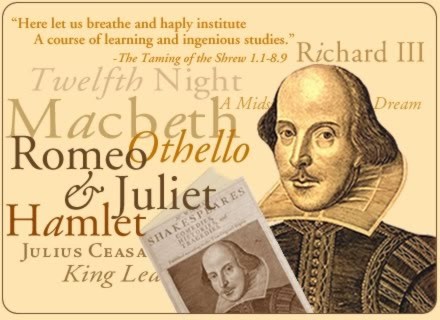
I was considered to be a little strange in school when it came to studying Shakespeare. Whilst my peers usually groaned at the thought of studying plays of the bard, I looked forward to sinking my teeth into these genius works, be it sonnet or play. I remember studying “Much Ado About Nothing” in the 10th grade, reading out the parts in a class of all girls (made interesting reading for the guys parts). I remember studying “Hamlet” in 12th grade, and having to redevelop the “Madness of Ophelia” and her subsequent suicide. I love the language and the imagery that it depicts.
Years go on, I found myself coming back to Shakespeare, rereading a few of the plays (mainly the tragedies). When I started university, I found a rather large book containing all the works of Shakespeare in the campus textbook shop. It was on special, for half of its usual price. A great mental debate ensued as to whether I should purchase it with the hundreds of dollars I was about to spend on my university curriculum texts. Needless to say; I did purchase it, and it now sits with my complete collections of Conan Doyle and Jane Austen. I will still often get that big book out to read aloud passages and sonnets.
Despite many people saying that they don’t like Shakespeare, the English language is riddled with the use of quotes, phrases and sayings in everyday speech (Phrase Finder). Everyone would be familiar with the “To be, or not to be” from Hamlet, or “Where for thou art?” from Romeo and Juliet. We’ve seen the movies that have been popularised into contemporary culture. Baz Luhrman’s “Romeo and Juliet”, “10 Things I Hate About You” (based on “The Taming of the Shrew”) and “Shakespeare in Love” (based loosely on Romeo and Juliet, and “The Twelfth Night”). We shouldn’t leave out the film versions that though are not popular now, were classics of their time, such as Elizabeth Taylor’s “Taming of the Shrew”.
Shakespeare even has an everlasting effect on theatre. “The Scottish Play” (Macbeth) has garnered a reputation of superstition in theatres around the world, due to calamities that often befell players, crews and theatres. It was probably due to the violence and sword fights that led to a lot of the incidences. It is considered bad luck to even mutter the name “Macbeth” in a theatre. If it is said, then it needs to be counteracted by saying, “If we shadows have offended, Think but this, and all is mended”, which is quoted from “The Midsummers Night Dream” (Act 5, Scene 1).
Shakespeare is the ‘go to’ in drama. All the brilliant monologues, soliloquies, and scene work of various topics, contexts and scopes to choose from. Shakespeare gave characters a vibrancy that is sometimes missed in contemporary drama. Most of the good actors have performed in a Shakespeare at sometime in their careers, whether it be in TV, film or theatre. I believe that Shakespearean play is at its best when on the stage, though I’m sure some would contradict me in this opinion.
So what sparked my love of Shakespeare to come from the back of my mind to the forefront? I recently watched National Theatre’s broadcast of “Hamlet”. Benedict Cumberbatch and the rest of cast (and staging crew) should be commended for bringing this play into a contemporary setting, whilst still keeping the original themes and language. For what is Shakespeare, without the language? These imagery used on stage is just brilliant, particularly when transition form scene to scene, and emphasising the speeches (love the ‘slow-mo in the background).

I would have to say that my favourite Shakespearean tragedy is Hamlet, just because it is a tragedy pretty much from start to finish. I love the monologues that Hamlet has, and the “Woe is me” speech told by Ophelia.
“What a piece of work is a man! How noble in reason, how infinite in faculty! In form and moving how express and admirable! In action how like an angel, in apprehension how like a god! The beauty of the world. The paragon of animals. And yet, to me, what is this quintessence of dust? Man delights not me.” – Hamlet; Act 2, Scene 2.
I also like the comic relief inserted within the seriousness of the play. The lewdness of some comments… Love it. There is also a lot of imagery in the play such as the suicide if Ophelia. You don’t actually see it, but it is described quite beautifully by Queen Gertrude. There is a lot of familiarity in the script of the play, that we use in our everyday language as well.
“There are more things in heaven and earth, Horatio, Than are dreamt of in your philosophy”. – Hamlet; Act 1, Scene 5.
It is often so that my like (dare I say it? Love) for Shakespeare reignites whenever I see a film or theatre production. If only I could see more of them, I would be a very happy girl indeed, but then I do enjoy the classics.
…and if anyone is asking. Yes, I am a Cumberbitch (or Cumbercollective; fans keep changing the name).


 Sarah Talbot
Leave a comment